Skip to content

CategoryMoney saving tips

Consolidate your debts and save money with today’s record low rates.

It’s December 2011, fixed mortgage rates are at historical lows…a 5 year fixed rate can be had for 3.39% and in some cases, even 3.29%.   Does it make sense to refinance your mortgage and consolidate that car loan, student loan, credit card, line of credit or other debt?   The answer is an overwhelming YES!

Compounding interest rates are a killer.  If you have $20,000 or more in non-mortgaged debt, then you should consider consolidation.   Especially with today’s record low interest rates.

Here’s an example of one situation:

 Rate  Balance  Payment
 Mortgage 3.99% $300,000 $1,349
 Car loan 6.00% $24,000 $563
 Credit Cards 18% $10,000 $300
 Line of credit 7% $10,000 $300
mortgage penalty $2,993 $0
 Totals $346,993 $2,512

And here’s what the new situation could look like after consolidating their debts:

 Rate  Balance  Payment
 Mortgage 3.39% $346,993 $1,533
 Car loan $0 $0
 Credit Cards $0 $0
 Line of credit $0 $0
mortgage penalty $0 $0
 Totals 3.39 $346,993 $1,533

So in this example, we are reducing the monthly payment by $979.00.     Let’s take some of that money and put it towards your new mortgage… if you took $500/mth and put this towards your mortgage for 5 years, you would reduce your amortization to 10 years and 7 months.   Clearly, this is worth breaking the mortgage and paying the penalty.

(keep in mind, the penalty could be higher if the lender uses an Interest Rate Differential to calculate the penalty… Always speak with your Mortgage Broker to ensure the penalty is accurate).


ING collateral mortgage began December 10, 2011..but no media coverage?

ING made it official and announced that all new mortgage applications submitted on or after December 10 2011, will be registered as a Collateral Charge.   Here’s a copy of the circular that was released….click here.

They join TD Canada Trust as just the second major lender to take this step and put the hand-cuffs on unsuspecting borrowers.   What’s different about ING’s move is that at renewal time, unlike TD, they will re-register a new collateral mortgage charge, at ING’s expense.    Strangely, I haven’t seen any major media coverage on this subject.  hmm, does this have anything to do with ING being the largest bank in the world??

SAY GOOD-BYE TO THE ‘UNMORTGAGE’ HELLO ‘MORTGAGE FOR LIFE’

But why should you care?  And what does it matter?  Well, this is about a few things.  CHOICE… they aren’t giving you one.  A collateral charge is normally used for loans and lines of credit.   There is no amortization.  And while that might be good for some, it’s not always good for all.  ING says you can refinance without having to incur new legal fees… yes, that’s true..however, you still have to be re-approved for any increase and negotiate your rate.   And the truth is, ING, just like all banks, doesn’t always have the lowest mortgage rates….don’t get fooled by their slick marketing ads…

FUTURE OPTIONS. It’s also about your future options… when it comes time to renew, and you want to switch your mortgage to another lender, you can’t… Collateral mortgages are NOT transferable.. you will have to deal with new legal fees… and ING knows this… so do you think they have to offer you the best rate at renewal time?

And speaking of the future, let’s look at a real possible scenario…suppose you need some money in a few years..   You have a great mortgage rate with ING.. it’s 3.64%… or it’s Variable Prime less 0.75%….  and now you don’t qualify for a mortgage increase.   With a conventional mortgage, you could always seek out a 2nd mortgage, but now you can’t… No 2nd mortgage lender will register behind a collateral charge.  You’re stuck with having to refinance the entire mortgage.   You lose, The Bank wins.

For me, ING and TD Canada Trust are not the first choice for mortgage lenders…

BMO announces lower rate IF you take a shorter amortization!

Have you heard the big news?   BMO lowers rate their best discounted 5 year fixed rate to 3.49%  to encourage Canadians to take an amortization 25 years or less.  They claim they want to encourage Canadians to pay their debt off faster…..  Sounds nice and in keeping with the Christmas spirit, doesn’t it?

Ok, before we get all warm-hearted and teary eyed, let’s take a closer look at what this really is.    First, this IS NOT the best discounted fixed rate in the market.   A good Mortgage Broker can get you 3.39% out there with no restrictions on amortization (even lower with some No Frills mortgage products).   We all want to pay our mortgage off faster, but choosing a shorter amortization only limits your future options…   My recommendation to almost all my clients is to take the longest amortization possible……

It’s not that I want you to have a mortgage forever, it’s about having options….  I always take a ‘what if’ approach….   Follow me for a minute…

Let’s say you had a $300,000 mortgage and you took this BMO 3.49% rate,  your payments on a 25 year amortization with be $1496.23/mth.   But if you took a truly discounted mortgage at 3.39% with a 35 year amortization, your minimum payment would be $1216.75/mth.   You could always INCREASE your payment to accelerate your amortization to 25 years or shorter.

Now, let’s say you lost your job, had some unexpected expense come up, or a financial emergency or just needed to lower your payments.   If you chose 25 year amort, then you are stuck with that payment.. if you chose 35 year, then you can always go back to that lower payment…    That’s the flexibility that we want.  It’s not about taking longer to pay, it’s about having the option to reduce your payment if needed.

LET’S NOT FORGET THE BANKS HISTORY WHEN IT COMES TO RATES

In keeping with the Christmas theme, Mr. Potter would be approve the Banks latest strategy.   In case you didn’t know, the 5 year Canada Bond is in record low territory…. hovering at around  1.31%… the 5 year fixed rates are priced from the bonds… the spread is normally around 1.25% to 1.40%… and yet today, the spread is 2.18%…. WOW!  and why?  TO MAXIMIZE PROFITS.   This is has nothing to do with wanting to helps Canadians. 5 year fixed rates should be under 3.00% but they aren’t, because the Banks want to maximize profits.

VARIABLE RATE PRICING IS AT 1990’s LEVEL

Variable rate pricing went from Prime less 0.90%, 3 years ago, to Prime plus 1.00% in during the October 2008 US mortgage crisis, to Prime less 0.75% just six months ago…. to Prime plus 0.20% today.    That’s right, Prime PLUS 0.20%.  Haven’t seen this pricing since the ’90s.  There are no fundamental reasons for this… it’s simply profit taking by the banks.. they are forcing us to take a 5 year fixed rate.   Sure, today’s 5 year fixed rates are at historical lows, so there is very little attention being given… but when rates go up, and they will in a few years, we will start to ask for more competitive products and better options other than a 5 year fixed rate….  (Can you see Mr. Potter’s grin getting larger?).

My advice… think about who your banker works for….and who your Mortgage Broker works for….

Why use a Mortgage Broker

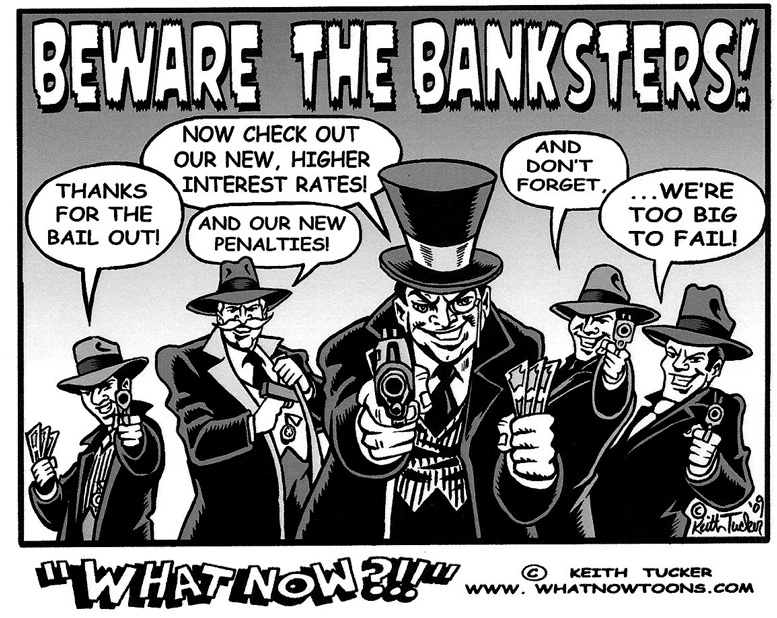
There was an article in the Globe and Mail recently entitled ‘Why use a mortgage broker?’.    No, this image wasn’t part of the article but it’s an image that many  will conjure up when we hear the word ‘Banker’.

The article talks about why Financial Planners and other professionals will recommend, and work with,  a Mortgage Broker vs. having the client go directly to the Bank.  Here’s a few quotes from the article that make it easy to understand.

  • “It’s the most efficient way to get the best-priced and best-structured mortgage”.
  • “So rather than shopping at multiple financial institutions and negotiating with each financial institution and arm wrestling them to give you the best deal, it’s one phone call and they do the rest for you.”

And here’s some facts from a Bank of Canada review published in February 2011 entitled ‘Competition in the Canadian Mortgage Market’:

  •  This one is no surprise…. “The results also indicate that borrowers who use a mortgage broker pay less, on average, than borrowers who negotiate with lenders directly”. 
  • Here’s one that may surprise many of you…  “The results also indicate that higher income households pay higher rates, on average, than lower-income households.”
  • And here’s another one…  “Banks also offer larger discounts to new clients than to existing clients.”

I’ll add a few more of my own….   A broker shops the market…doesn’t work for any one lender but instead works for the borrower….. and provides the borrower with clear, neutral and unbiased advice.    Brokers save borrowers money and will continue to shop for better rates at renewal and throughout the life of the mortgage…

A look back at Oct 2008 and the Bank’s kool-aid..

October 2008 will be remembered for a few reasons….. First, it was Obama’s rise to the presidency… the first black American president…. next, it was also the end of Lehman Brothers investment bank and the beginning of one of the biggest global recessions in modern history…

That’s how most of us will remember October 2008….. but  there was also another very memorable event that took place.  You see, it was around this time that I heard some borrowers were getting calls from their Bank to lock-in their Variable rate mortgages…. or to take a long term fixed rate mortgage to ‘protect themselves from the uncertainly’ that surrounded the markets at the time…. I warned mortgage borrowers to expect a call  from their Bank offering a ‘safer mortgage option’ or some ‘special offer’ to lock into a fixed rate or a long-term rate…and NOT to take such offers or deals….

Can you imagine a Bank advising or recommending that you lock in your Variable rate or to take a long-term Fixed rate at that time?    At the time, Variable rates were are at around 3.35% and 5 year fixed rates were at around 5.75%.   Uh, no thank you… I’ll pass on the bank kool-aid.

The funny thing about uncertainty is that it usually brings us lower interest rates…..not always, but during this time we knew the World Banks would work together to lessen the economic impact of the Lehman Brothers collapse.   Unfortunately, there were far too many borrowers that listened to their banker and locked into the much higher Fixed rates…

The moral of the story is that Bankers and their ‘Mortgage Specialists’ work for one company, one Bank… they can only offer you one set of products and MUST do what’s in the BEST interests of their BANK…. They have to drink the Bank koolaid….   Mortgage Brokers can offer the products from dozens of lenders and can also compare the benefits and differences between Banks… Remember to ask questions and opinions from neutral, unbiased professionals.

Don’t drink the kool-aid…