Skip to content

CategoryReal Estate news

I’m getting divorced. Should I keep the family home?

Divorce Image, March 2018

You’ve heard the stats: 1 out of every 2 marriages fails. Actually, I think the number of failed marriages is even higher now. Wait, let me rephrase that. A marital split is not a failure. I think that’s old-world thinking. A marital split is usually a positive move for all parties involved – for the spouses who are no longer in love and the kids who don’t have to see an unhappy married couple.

Marital splits can be a very emotional and difficult time in one’s life – especially when there are kids involved. There’s always one parent who wants to keep the house because the kids grew up there or have friends there or it’s just more familiar to them.

Having worked on 8,000+ mortgage applications at this stage in my career, I’ve witnessed my share of separations and divorces. I’m going to share what I’ve seen – a financial and personal perspective on marital splits.

Continue reading “I’m getting divorced. Should I keep the family home?”

Yes, you can still buy a home in Canada… Keeping the dream alive

Homeownership Image, March 2018

Canada’s a nation of immigrants. It truly is the land of opportunity. Chances are, your parents, grandparents or great grandparents came here from another country.

There are many reasons why people left their homeland. Some left by choice to pursue a better life. Others had to leave for safety reasons. Whatever the reason, most of us have a common goal: A better life.

Homeownership has always been an important part of that dream. We want to own something. We want to plant roots. There’s a pile of statistics to support this claim. In my 28 years in the financial services industry, I can attest to this claim.

Continue reading “Yes, you can still buy a home in Canada… Keeping the dream alive”

Interest Rates are Rising… and Expected to Continue… But!

December Blog Image

Rates have been rising gradually over the past six months following several years of historically-low rates. There should be no surprise that rates are rising – it was bound to happen. But, we can be thankful they’re not predicted to spike. It’s much easier to deal with – and plan for – gradual increases.

Benjamin Tal, Deputy Chief Economist of CIBC World Markets Inc, spoke last week about his predictions for rates and a bunch of other economic indicators. I’ve been following him for 15 years now. He’s one of the few economists whom I respect, as his forecasts have proven very accurate. So, let’s pay attention!

Continue reading “Interest Rates are Rising… and Expected to Continue… But!”

OSFI announces strictest mortgage rules ever… what you need to know.

HARDER TO QUALIFY WITH 50% DOWN THAN WITH 5% DOWN.. DOES THIS MAKE SENSE?

October 2016, our Federal govt announced a number of new mortgage rules including the infamous new ‘stress test’ for all insured mortgages.  Mortgage default insurance is required for all mortgages greater than 80% loan to value.  You have to qualify at the bank posted 5 yr fixed rate, which is usually around 1.75% to 2.00% higher than your actual rate, and with a maximum amortization of 25 yrs max.

These ‘rules’ were brought in last year to protect us from ourselves.   To ensure we could handle any large interest rate hikes at renewal time.  Sort of like big brother watching over us to make sure we don’t borrow more than we can afford. (btw, we already had lending rules in Canada.  Our mortgage arrears were and still are at record low levels.   Seems like our Banks, credit unions and other lenders are doing a pretty good job of lending.  Is more govt intervention necessary?  Most experts say no.)

Today, Jeremy Rudin, OSFI Superintendent, joined the party…. well, more like rained all over ever Canadian homeowner’s party (current and future).   OSFI, not wanting to be left out, announced they would impose more mortgage rule tightening for all mortgages that were UNDER 80% loan to value.    Again, to protect us from ourselves just in case interest rates should sky rocket at your renewal time.   Here’s a summary of the changes and how they will impact consumers, homeowners, and the real estate market:

  • A new minimum qualifying rate for uninsured mortgages.  The ‘stress test rate’ will be your contract rate + 2.00% or the 5 yr posted fixed rate, whichever is greater.(that’s right, your may have to qualify at a higher rate than those with insured mortgages above 80% loan to value.. how does that make sense?)
  • Federally regulated financial institutions must establish and adhere to appropriate Loan to value limits that are reflective of risk and updated as housing markets and the economic environment evolve (yeah, I’m not quite sure what this one means either.. stay tuned)
  • Federally regulated financial institutions are prohibited from arranging with another lender a mortgage, or combination of a mortgage and other lending products, in any form that circumvents the institution’s maximum Loan to value ratio or other limits in its residential mortgage underwriting policy. (this has dire consequences for those that won’t meet this historic new ‘stress test’.. effectively, the govt is telling you to not buy a home if you don’t fit in this new shrinking qualifying box…. or sell your home if you need to access the equity..)


HOW THIS AFFECTS YOU

  • buying with less than 20% down payment, no effect.  You already have a ‘stress test’.
  • buying with more than 20% down and you’ll have to pass a tougher test, that’s right, a tougher test than those with less than 20% down.  (Make any sense to you?  me neither.)
  • around another 15% of homeowners will NO longer qualify for a mortgage regardless of it being a purchase or if you wanted to refinance.
  • expect rental, condos or houses to become way more expensive as demand will spike.
  • we’ll see a spike in real estate sales from now until Jan 1st as homebuyers will scramble to get in prior to the new rules taking effect.
  • most credit unions are provincially regulated and for now, won’t be affected..  (that could change if the provinces amend their rules)


POSSIBLE SOLUTION TO DISCOURAGE HOME SPECULATORS BUT ENCOURAGE HOME OWNERSHIP

If you want to discourage speculators, make them hold the property for 5 or 7 years.  Bring in a declining speculation tax for anyone that sells a non-owner occupied home in less  than 5 years.  Reward those that hold real estate for longer periods.  You’ll have less transactions.  Encouraging longer holding times, more rental units on the market and higher vacancies.  More rental supply will also resolve high rents.  Bring back more realistic mortgage qualifying guidelines.  Encourage and promote buying investment properties.

A year ago, the Federal govt made several rule changes that effectively made it more expensive and difficult for consumers to borrow.  The list of changes was so long that most Canadians didn’t bother to react because it didn’t affect them that day.  But as we are seeing now, more consumers are experiencing reduced access to mortgage money.   They can’t refinance their mortgage.  They can’t draw on their built up equity in their homes.  It’s only when you need to borrow do you realize the extent of the changes.  Each and every one of us will be impacted.   These new policies will only make home ownership more difficult.  It will also slow our economy.

Perhaps the credit unions can pick up the slack and help …  stay tuned.. there will be more to share on these changes.     One thing is for certain.  You need to speak with an experienced Mortgage broker to understand what your options are.  It’s almost impossible to go it alone.. and you don’t have to.  Mortgage Brokers work for you, not the Bank.  They have access to dozens of competing lenders.

Your best interest is my only interest.   I reply to all questions and I welcome your comments.  Like this article?  Share with a friend.

Steve Garganis 416 224 0114 steve@mortgagenow.ca

Spring housing market in the Fall?

Fewer homes in the summer.  Lower average home selling price in the summer.  That’s this year’s headline.  But it could also apply to last year or the year before or the year before that.

What hasn’t been said much is that house prices almost always go up in the Spring and fall during the summer. 

This year isn’t much different.  Except that this Spring, we saw ridiculous price increases in the 20% range.

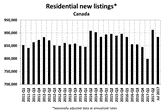
That’s just not sustainable.  Check out some of these graphs from Canadian Real Estate Association.

This summer, house prices have fallen a little more than average.   And sales are also down compared with the last 2 years.  But listings haven’t increased.  In fact, listings dropped in July signalling we could have reached the bottom.

Hey, if we were in a housing bubble, you would have seen new listings continue to spike up.  That’s when we know the market will have changed gears.


PENT UP BUYER DEMAND?

Some are speculating that we could see a busy Fall market this September or October.  The Fall has historically been the 2nd busiest housing market.    If we look at Vancouver in 2016, after they announced their 15% Foreign tax rule, their market went soft and was very quiet.  Many pessimists were saying it was the bubble bursting.

Six months later and Vancouver’s market is busier than ever. Fully recovered.  The initial shock of the Foreign tax rule came and went.   We could see that same sort of comeback for Toronto.

A WORD TO OUR FEDERAL GOVERNMENT AND REGULATORS…

To the Federal govt:  Please, no more mortgage rule changes.  Let the market absorb all the massive changes already made.  Listen, I’m telling you with 28 years of mortgage lending experience.. I can’t recall when qualifying for a mortgage has ever been harder… and I was around during the last real estate recession of 1990.

Non-bank lenders are being penalized as their cost of funds are higher than BIG SIX BANKS (thanks to the new Fed govt mortgage rules), hence driving more customers towards the BANKS… THE WINNERS:  BIG SIX BANKS.  THE LOSERS: CONSUMERS. Let’s bring back competition among Mortgage Lenders… and let’s make mortgage financing accessible again.  The pendulum has swung way too far to the conservative lending side.

BANK OF CANADA RATE HIKES ON HOLD?

The Bank of Canada hiked the Prime rate by 0.25% in July.  It was headline news for weeks.  Many said this was the 1st of many hikes to come.  Today, the forecast is for a possible October hike.  But that isn’t a sure thing.  And if the uncertainty with the housing market continues or if the NAFTA trade agreement gets turfed like President Trump says, you can bet the Bank of Canada governor will think twice about raising the rates.   More likely a rate drop!

Stay tuned.. Maybe we’ll see a Spring market in the Fall?

Your best interest is my only interest.   I reply to all questions and I welcome your comments.  Like this article?  Share with a friend.

Steve Garganis 416 224 0114 steve@mortgagenow.ca