Skip to content

CategoryMortgage Products

ING collateral mortgage began December 10, 2011..but no media coverage?

ING made it official and announced that all new mortgage applications submitted on or after December 10 2011, will be registered as a Collateral Charge.   Here’s a copy of the circular that was released….click here.

They join TD Canada Trust as just the second major lender to take this step and put the hand-cuffs on unsuspecting borrowers.   What’s different about ING’s move is that at renewal time, unlike TD, they will re-register a new collateral mortgage charge, at ING’s expense.    Strangely, I haven’t seen any major media coverage on this subject.  hmm, does this have anything to do with ING being the largest bank in the world??

SAY GOOD-BYE TO THE ‘UNMORTGAGE’ HELLO ‘MORTGAGE FOR LIFE’

But why should you care?  And what does it matter?  Well, this is about a few things.  CHOICE… they aren’t giving you one.  A collateral charge is normally used for loans and lines of credit.   There is no amortization.  And while that might be good for some, it’s not always good for all.  ING says you can refinance without having to incur new legal fees… yes, that’s true..however, you still have to be re-approved for any increase and negotiate your rate.   And the truth is, ING, just like all banks, doesn’t always have the lowest mortgage rates….don’t get fooled by their slick marketing ads…

FUTURE OPTIONS. It’s also about your future options… when it comes time to renew, and you want to switch your mortgage to another lender, you can’t… Collateral mortgages are NOT transferable.. you will have to deal with new legal fees… and ING knows this… so do you think they have to offer you the best rate at renewal time?

And speaking of the future, let’s look at a real possible scenario…suppose you need some money in a few years..   You have a great mortgage rate with ING.. it’s 3.64%… or it’s Variable Prime less 0.75%….  and now you don’t qualify for a mortgage increase.   With a conventional mortgage, you could always seek out a 2nd mortgage, but now you can’t… No 2nd mortgage lender will register behind a collateral charge.  You’re stuck with having to refinance the entire mortgage.   You lose, The Bank wins.

For me, ING and TD Canada Trust are not the first choice for mortgage lenders…

ING collateral charge in 2012.. hand-cuffs included

You’ve seen the ads…  That fellow with the Dutch accent and the orange background, telling us to ‘save your money’.  Since 1997, when they first entered Canada, they have grown to 1.7 million clients and $37billion in assets.  ING spends millions in marketing… They’ve created a brand that is synonymous with saving or discounts.

Today, I just heard they will be counting on that trust.  It is rumoured ING Direct will begin registering ALL mortgages as collateral charges.   They join TD Bank as the second major lender to make this bold change.    A move that has great implications for the Canadian consumer.

It was almost one year ago when TD Bank announced they would register all their mortgages as a collateral charge.  (click here for the details of what a collateral mortgage is and some reactions).   Consumer advocates spoke up and warned against getting a mortgage like this…. Strangely, the media was silent.  (hmm, I wonder how much TD spends in media advertising???).

In short, the benefit is that you will be able to increase your mortgage without having to spend money on new legal fees….ok, that saves you around $800 to $1,000.  That’s your benefit.  (but even this has changed as there are some programs that will offer a discounted legal fee).

Here’s what you lose….you give up your leverage to negotiate the best rate… and that’s because if you want to leave ING, you cannot simply transfer your mortgage… Collateral mortgages cannot be transferred.     You still have to qualify for any increase… you must trust that the Bank has your best interest at heart….   Hey, remember when all the banks raised their lines of credit rates in 2008-09 without warning?

ING has been a great Lender, but this new move will drive away most advisors, mortgage brokers and clients that want options and flexibility..

I’ll continue to report more as this story breaks..

Stock market drop and slight recovery.

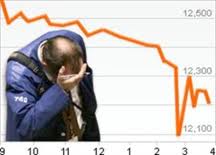
Did you know that between July 22nd and August 8th, the TSX index dropped 14%?   Did you know that since August 8th, it has recovered 9% of that loss?  What a roller coaster ride…But there’s good news here…

So how will this affect your mortgage rates?

Fixed mortgage rates are priced from the 5 year Cda govt bonds.. Bond yields also dropped like a rock.. from 2.27% to 1.35% during that same time period…  that’s a 0.92% decrease.  A visit to TD Bank’s website shows us their ‘5 year fixed rate Special offer’ is 4.19%... no drop at all.   Call a Mortgage broker and you’ll see rates of around 3.49% today.

Sure, fixed rates are very low but they should be lower….  Fixed rates are usually priced around 1.30% to 1. 70% above the 5 year bond yield…  Why haven’t you seen mortgage rates keep pace with the bond yield drop?   That’s not hard to figure out… The Banks are maximizing their profits… same old story…Banks are infamous for hiking rates quickly and but slow to move when it comes to cutting rates.

How about Variable rates?

Well, not much to report there… The Bank of Canada meets 8 times a year.   Last meeting was July 19th.  Next meeting is Sept 7th.    You can forget about any immediate rate hike.   Economists have done an about-face with their forecasts…. We were expecting a rate hike this September or October… That’s now been pushed back to 2012… and there were even some rumblings about a possible BOC rate cut (but I’m not sure that’s gonna happen).

At 3.00%, the Bank Prime rate is still very, very low and makes borrowing very attractive…   Current Variable rate mortgages are priced at between Prime less 0.65% to 0.80%…    We may not see interest rates drop, but there is no reason for them to go up for the next little while…. Enjoy the low rates.

U.S. looking at Canada’s mortgage and banking yet again..

Found this article interesting….

Canada is the envy of the world when it comes to our mortgage and banking regulations.   This article in the Huffington Post questions why is there a 30 year fixed rate mortgage term and points to Canada’s mortgage and banking system as a better, more viable option.

In case you didn’t know, 30 year fixed rate terms are the norm in the U.S.   5 year Variable rate mortgages are the more common mortgage product around the world, including Canada.   200 U.S. Banks have failed since 2008… NONE in Canada… and in 1985, almost 3,000 U.S. banks failed but only 2 Canadian Banks closed their doors....

Go ahead Canada, feel good about yourselves…!

New Cashback mortgage offers are finally worth looking at!

The old Cashback mortgages

As a general rule, cashback mortgage offers have never really worked to the benefit of the borrower.  The Banks loves it when a borrower takes one of these deals because it costs the borrower more, earning a higher profit for the Bank.

A cashback mortgage is easy to understand….  The Bank will usually give you Posted Bank Rates with some cash back on closing… The cash back is depends on the term of the mortgage but it’s usually been between 2% and 5.5% of the mortgage balance.

If you have a $250,000 mortgage, the thought of getting $5,000 to $13,750 back in cash on closing sounds pretty good…  But let’s take a closer look…

If you do the math, this usually works out to around a 0.60% to 1.10% discount off Posted Rates.  Today’s posted 5 year fixed is 5.69%… that would give you an effective fixed rate of around 4.59% at best… Compare this with today’s wholesale discounted fixed rates of 4.19% and the REAL cost of getting that 5.5% cashback means you will pay $4,767 more over the 5 year term.

The New cashback mortgages

Recently, we came across an interesting offer from one of the major Lenders….  Thought we’d share the details…

-5 year fixed rate of 4.29% with a 2% cashback for mortgages under $400k gives an effective rate of 3.89%…and 3% cashback for mortgages over $400k gives an effective rate of 3.69%.

-5 year variable rate of Prime less 0.50% with a 2% cashback for mortgages under $400k gives and effective rate of Prime less 0.90%.. and a 3% cashback for mortgages over $400k gives and effective rate of Prime less 1.10%

Note: if you were to apply the cashback at the time of closing, the effective rates would be even lower.

There is a catch…These cashback offers are only available for mortgage refinances or transfers from other financial institutions… they are not available for purchases (we don’t understand why but that’s the deal)…  AND  you CANNOT pay these out early with giving back the entire cashback to the Lender…It is also a little harder to qualify for these products and the approval process is a much more involved and time consuming…  You will definitely want your broker to be involved in helping processing the approval…  (don’t be surprised if your broker has to charge you a small fee for their time…it will still be well worth it.)

I must say, even with these limitations, it  may still be worth considering.   It’s good to see some more competition in this segment of the mortgage market.