Skip to content

Scotiabank says Bank of Canada won’t move till October

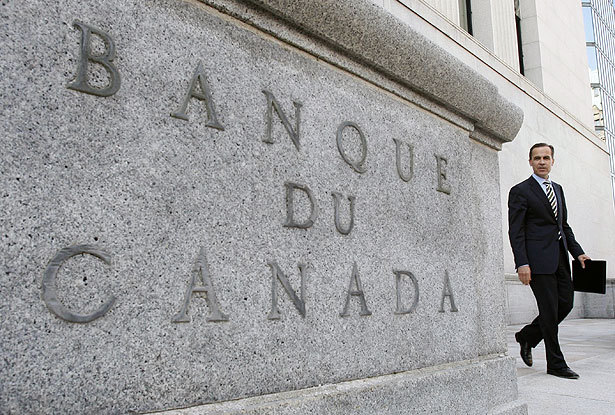
Last week, the Bank of Canada (BOC) kept it’s Target Rate unchanged for the 4th consecutive meeting.  That’s means Bank Prime is still 3.00%.  Many Experts and Economists think the next rate hike will come as early as April or as late as June….

But not all Economists agree.  Scotiabank’s economists say the rate will remain unchanged til October.   They give a detailed explanation as outlined in this National Post article... but the main reasons are:

  • high $Canadian Dollar (an increase by BOC usually increases the $CAD)
  • global uncertainty… the middle east turmoil and European debt worries
  • tougher financing rules including the new mortgage rules
  • U.S. Fed not expected to raise their rate til next year…any increase by the BOC would push the $CAD even higher and make our exports even more expensive
  • possible Federal election in Canada coming soon.. and provincial elections this year…  history tells us that rates are usually flat during election time.

The Scotiabank economist make a good argument.   I like the political reason… History shows us politics play a big role in the BOC actions….  Enjoy the low rates… They seem to be here for a while.

Bond yields fall after Middle East turmoil

Earlier this month, we saw Fixed mortgage rates go up and the forecasts were calling for rates to continue to go up over the next 2 years.   It’s important to remember that all forecasts make certain assumptions and don’t allow for the unexpected… These forecasts may still be accurate but of course, no one was expecting the uprising in Egypt, now Libya and possibly other Middle East countries…

The Canada Bond yield has dropped around 22bps to 2.58% from a 10 month high of 2.80%.    This takes some of the pressure off to raise fixed rates… and we might even start to see some Fixed rate decreases if the Bond yields fall further…(or course, the Banks are famous for raising rates immediately but lowering them slowly and this was even identified by the most recent Bank of Canada quarterly review)

I can’t help but to reflect on Professor Moshe Milevsky’s article from a few weeks about how to deal with rising interest rates…. In this article he cautioned us about overreacting to warnings of huge rate hikes or calls to lock in your mortgage…    Wow, the timing of his article couldn’t be more perfect.   I recommend you take a moment and read what the Professor has to say.

TD and RBC CEO’s income $11million each for 2010…

Are the BIG SIX Bank CEO’s that good?

It’s that time of the year again… when Bank CEO salaries have to be reported… TD’s CEO Ed Clark earned $11.3million on profits of $4.6billion in 2010, RBC’s CEO Gord Nixon pocketed $11million. Congratulations….!   Staggering numbers considering that we are just coming out of (hopefully) the worst recession ever… click here for more on Bank salaries.

So what’s the problem?

There has been so much publicity about how strong our Canadian Banking system has been through this recession…. And yes, it’s true.. we have held it together very well.  But was it that our Bankers were that smart or just that far behind the times??

It has been said that Canada is always 5 years behind the U.S. Ever heard that saying?  Well, it’s true for many things, including Banking and Financial Services…   In 2006, we saw the introduction of 30, 35 and then 40 year amortization mortgages. We also saw $0 money down mortgages….. Interest only mortgages!! 107% loan to value financing!!!

These products were beginning to gain some popularity in Canada.. but then in October 2008, the U.S. mortgage crisis hit… and all the new products were pulled from the shelf.   Imagine if these products were introduced to Canada 5 years earlier…. Imagine how many of us would have been affected….  Don’t be fooled into believing that it was our Banking system that saved us…

Look, the plain truth is that we got lucky… we were a bit slow to embrace these products… and that’s really our infamous Canadian conservatism coming out… It’s got nothing to do with our Bankers being that much smarter… It’s got everything to do with you, the general public, the average Canadian, not taking to change quickly…. This is the real reason we didn’t suffer a worse fate.

How much did mortgage penalties contribute to Bank Profits?

Here’s a bit of math to play with…. Statistics tell us that on average, Canadians move or refinance their mortgage every three years…. The stats also tell us that approximately 75% of all mortgages are in a fixed rate term… I would venture to guess that probably 95% of those are in a 5 year fixed rate….  Okay, so now let’s look what the average penalty would cost you to break your mortgage…

And today, I have another example that I will share with you… it’s about a young couple that needed some help….  (I get these almost daily, by the way)….

A $250k mortgage with a 5.15% rate with 28 months til maturity…  The penalty quote to break the mortgage was $11k... I gave some advice and helped to get it down to $8k...    That penalty still works out to over 7 months interest. Can you say ka-ching!!   The Banks have made an absolute fortune on the backs of unsuspecting Canadians….

The Govt and the Banks should tighten credit card rules

Last November, the Banks pressured the Federal Govt to tighten mortgage lending, to make it harder to take a Variable Rate Mortgage… to make it harder to refinance your debts into a mortgage….  The results are bad for Canadians.. we now have to take a 5 year fixed rate mortgage in many cases… we now have to keep our higher interest credit card debt, loans, and other debt….  Canadians are being forced to keep these higher interest debts while Banks increase their profit margins…  Here’s a great article about Household Debt..

By the way, there are no rules for giving out a credit card…

Report shows Canadian borrowers are too complacent…don’t drink the koolaid.

That’s what a report in the latest Bank of Canada Review had to say…    This article in the National Post sums it up well…  “Simply put, borrowers are often complacent and end up paying more than they should.

This is exactly the reason I started this site…..To make you an informed borrower. Like the review said,  “consumers have different preferences and skills when shopping and bargaining for a mortgage and where lenders maximize profits based on observing these preferences and skills.”

So, how does the average Canadian borrower know if they are getting the absolute best rate or the right mortgage product?  Is there a better product with a different Bank, Financial institutions or other Lender?  How do you know if you aren’t speaking with an unbiased professional that doesn’t work for any one bank?  For me, there is only one sure way to know you are getting a highly competitive mortgage product…..You must deal with a Mortgage Broker.

Here’s another quote from the Bank of Canada Review…  Canadian lenders appear to be extremely slow to pass on changes in the Bank Rate to their customers.”  I’m sure this comes as no surprise to most of us.

Never forget that the Banks are a business… and they are here to make a profit… It’s imperative to seek unbiased, market neutral advice…..  A Bank Mortgage Specialist just can’t be neutral or unbiased….They can only offer one set of products…  I save the best for last….

A Mortgage Broker helps to ‘creates competition’ as the report said.

Hopefully, this site will keep you informed and awake…Don’t settle for the status quo….

The Big Six have all raised their rates now…

A look at locking into a Fixed rate

By now, you’ve heard that Fixed Mortgage rates have gone up by 0.55% since November…5 year fixed is currently sitting at around 4.04% vs 3.49%.  (these are best broker rates…the best retail bank rates are 4.39%)…. Let’s take a closer look at what this will cost you.

On a $200,000 mortgage with a 25 year amortization, your monthly payment goes up by $58.89 or about $3,500 over a 5 year period.    That’s quite a bit of money…. and this probably gets a lot of us thinking about locking into a 5 year fixed rate….But is this the right strategy for everyone?

For some of us, it will make sense to take a 5 year fixed rate… this is not a bad option for those on a tight budget, pension income, or just can’t sleep at night thinking about rates…  make sure you are locking in for the right reason…

A look at NOT locking into a Fixed rate

Current Variable is 2.25%….  A $200,000 mortgage with a 25 year amortization has lower monthly payments by $185.16.  Okay, I know what you’re thinking and you’re right… this rate will not remain the same for 5 years.. In fact, we know it’s probably going to go up.   So it’s difficult to calculate exactly how much you would save or lose by sticking with a Variable rate…  History shows us Bank Prime goes up and down around 2 to 3 times a year….Look at this chart of Historical Rates. The RBC is forecasting for Bank Prime to go up by 1.00% this year and another 1.50% next year!!  (not sure I agree with this forecast).     If you like flexibility, are willing to tolerate rate movements, and want to take a calculated risk of floating your rate, then Variable could be a great option for you.

Is Variable rate more stable than Fixed rate?

The media keeps telling us mortgage rates are going up.. they will skyrocket….So why are people still considering Variable Rate mortgages?   We looked a little deeper and found some interesting trends…

-From Oct 2008 (the month of the U.S. Mortgage crisis) to Oct 2009, the Bank of Canada only changed Bank Prime 4 times…This was the worst recession since the Great Depression of 30’s….and yet Bank Prime only changed a handful of times….

-the BOC raised rates in 1992 because they thought the economy was strong enough to handle… they quickly lowered them but it was a little late as the economy staggered for another few years… this pattern has repeated itself on more than one occasion…most recently, 2010…

-the BOC forecasted that interest rates would skyrocket in mid to late 2010… they were wrong…

-Variable rate has historically been 1% to 3% lower than fixed rates.

Conclusion….Variable rate moves less often than Fixed rates… And yes, it’s more stable if you measure stability by rate movements… But there will be movement.. and maybe that’s what makes Variable rate a choice for only 25% of Canadians…  Us Canadians are a conservative bunch, or so our rep goes….  And by the way… The Banks would LOVE to have everyone take a 5 year fixed rate.. these are the most profitable mortgage products for them…. Keep that in mind…