Skip to content

CategoryMortgage Trends

New Cashback mortgage offers are finally worth looking at!

The old Cashback mortgages

As a general rule, cashback mortgage offers have never really worked to the benefit of the borrower.  The Banks loves it when a borrower takes one of these deals because it costs the borrower more, earning a higher profit for the Bank.

A cashback mortgage is easy to understand….  The Bank will usually give you Posted Bank Rates with some cash back on closing… The cash back is depends on the term of the mortgage but it’s usually been between 2% and 5.5% of the mortgage balance.

If you have a $250,000 mortgage, the thought of getting $5,000 to $13,750 back in cash on closing sounds pretty good…  But let’s take a closer look…

If you do the math, this usually works out to around a 0.60% to 1.10% discount off Posted Rates.  Today’s posted 5 year fixed is 5.69%… that would give you an effective fixed rate of around 4.59% at best… Compare this with today’s wholesale discounted fixed rates of 4.19% and the REAL cost of getting that 5.5% cashback means you will pay $4,767 more over the 5 year term.

The New cashback mortgages

Recently, we came across an interesting offer from one of the major Lenders….  Thought we’d share the details…

-5 year fixed rate of 4.29% with a 2% cashback for mortgages under $400k gives an effective rate of 3.89%…and 3% cashback for mortgages over $400k gives an effective rate of 3.69%.

-5 year variable rate of Prime less 0.50% with a 2% cashback for mortgages under $400k gives and effective rate of Prime less 0.90%.. and a 3% cashback for mortgages over $400k gives and effective rate of Prime less 1.10%

Note: if you were to apply the cashback at the time of closing, the effective rates would be even lower.

There is a catch…These cashback offers are only available for mortgage refinances or transfers from other financial institutions… they are not available for purchases (we don’t understand why but that’s the deal)…  AND  you CANNOT pay these out early with giving back the entire cashback to the Lender…It is also a little harder to qualify for these products and the approval process is a much more involved and time consuming…  You will definitely want your broker to be involved in helping processing the approval…  (don’t be surprised if your broker has to charge you a small fee for their time…it will still be well worth it.)

I must say, even with these limitations, it  may still be worth considering.   It’s good to see some more competition in this segment of the mortgage market.

Inflation rate drops in February and rate hikes pulled back.

It may seem hard to believe  but Canada’s core inflation rate is down in February to lowest level since 1984 as reported by CBC.  It’s now 0.90%.

Filling up my car at the gas pumps or buying groceries is certainly costing me more… So how can the inflation rate be lower be lower?

The Core inflation rate strips away food and energy costs resulting in a lower rate of inflation.

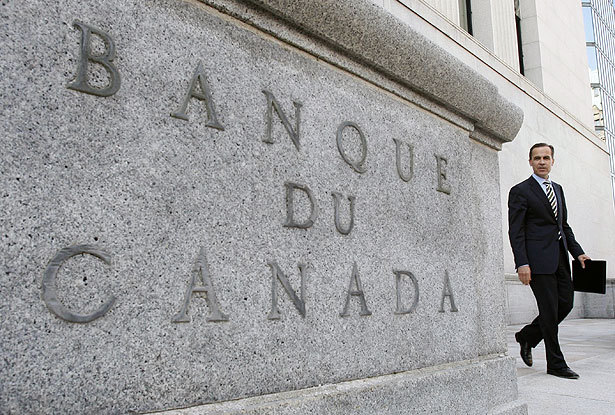
The Bank of Canada has a Target inflation rate of 2%.  The Target range is 1% to 3%.  When you combine a high Canadian $dollar that is at par with the $US dollar and this low inflation rate, the Bank of Canada less likely to raise the Target Rate….for now.

Here are a few forecasts…  Citigroup says a rate hike will not take place in April but instead, July.  And retired RBC Chief Economist, Patricia Croft says to watch the Bank of Canada 2 year bond yields for an indication of where the market thinks rates are headed.   The yields have dropped from 1.90% to 1.68%.    She says the market thinks rates won’t go up til October and only by 35bps.  But she thinks we should be ready for summer rate hikes.  The next few inflation reports will play a big part in the Bank of Canada’s future decisions.

I tend to agree with both forecasts… Summer rate hikes are  likely…. but I’m not sure how high and how quickly these rate hikes will happen.   We’ll be watching and reporting.

Scotiabank says Bank of Canada won’t move till October

Last week, the Bank of Canada (BOC) kept it’s Target Rate unchanged for the 4th consecutive meeting.  That’s means Bank Prime is still 3.00%.  Many Experts and Economists think the next rate hike will come as early as April or as late as June….

But not all Economists agree.  Scotiabank’s economists say the rate will remain unchanged til October.   They give a detailed explanation as outlined in this National Post article... but the main reasons are:

  • high $Canadian Dollar (an increase by BOC usually increases the $CAD)
  • global uncertainty… the middle east turmoil and European debt worries
  • tougher financing rules including the new mortgage rules
  • U.S. Fed not expected to raise their rate til next year…any increase by the BOC would push the $CAD even higher and make our exports even more expensive
  • possible Federal election in Canada coming soon.. and provincial elections this year…  history tells us that rates are usually flat during election time.

The Scotiabank economist make a good argument.   I like the political reason… History shows us politics play a big role in the BOC actions….  Enjoy the low rates… They seem to be here for a while.

Bond yields fall after Middle East turmoil

Earlier this month, we saw Fixed mortgage rates go up and the forecasts were calling for rates to continue to go up over the next 2 years.   It’s important to remember that all forecasts make certain assumptions and don’t allow for the unexpected… These forecasts may still be accurate but of course, no one was expecting the uprising in Egypt, now Libya and possibly other Middle East countries…

The Canada Bond yield has dropped around 22bps to 2.58% from a 10 month high of 2.80%.    This takes some of the pressure off to raise fixed rates… and we might even start to see some Fixed rate decreases if the Bond yields fall further…(or course, the Banks are famous for raising rates immediately but lowering them slowly and this was even identified by the most recent Bank of Canada quarterly review)

I can’t help but to reflect on Professor Moshe Milevsky’s article from a few weeks about how to deal with rising interest rates…. In this article he cautioned us about overreacting to warnings of huge rate hikes or calls to lock in your mortgage…    Wow, the timing of his article couldn’t be more perfect.   I recommend you take a moment and read what the Professor has to say.

Personal debt level up…uhh, wait.. maybe we made a mistake?!

As you know, I have been very critical about the data that was being put out over the past few months regarding Canada’s personal debt levels.. We were being bombarded with reports and comments about our spending habits… I found it hard to believe that we could go from conservative nation to a casino nation in just a few years…

Sure, there is more debt…. Outstanding mortgage balances topped $1trillion for the first time… but we seemed to be growing at a moderate pace, year over year.. We didn’t have the 20% to 30% increases in real estate prices that we saw in 1987-89, or like our neighbors in the U.S. over the past decade.  Meaning there was less chance of a housing bubble or crash.

And what about our assets….?  It was hard to find any report about our net worth or assets…  There was one report from Ben Tal, Senior Economist CIBC, that didn’t get much notice but we reported it here on December 3rd…  here are some of those stats…

-there are 12.5million households in Canada…31% rent, 69% own..

-of the 69% that own, 39.9% have a mortgage and 28.9% have no mortgage.

-69% of homeowners with a mortgage have more than 20% equity in their homes… only 30% have less than 20% equity in their homes.

click here for the full story..

And now for the real stats

Personal debt to disposable income ratio has been reported at 148%… This figure has been recycled more than that gift bag from the wine store you received at Christmas…. and just like that gift bag that gets passed around from friend to friend, it comes with a different bottle… or in this case, different figures and opinions.

Let see how you like this vintage….   Some new reports just came out that should ease our concern about our personal debt levels and average net worth.  “Average household net worth has risen to an impressive six times the size of disposable income, up from an average of five times in the 1990s.”  That’s a quote from BMO’s Senior Economist, Sal Guatieri…  read more here.

What’s this?  You mean Canadians are actually investing their money and not spending it frivolously like the Federal Govt has been telling us for the past several months?

It gets better…

Here’s a little more info from CIBC Bank..   Those figures had to do with the personal tax refunds we were getting last year because of the stimulus packages…. Household debt in the third quarter grew at the slowest pace in nine years, while in the last month for which there is data — October 2010 — it was the softest in 15 years.read more here.

That’s right, WE ARE SPENDING LESS AND OUR ASSETS ARE GROWING FASTER THAN IN THE 1990’s. … But how can this be?  The Federal Govt has been telling us that our personal debt levels are at dangerous levels…  and they had to change mortgage rules to slow our spending habits….. Any of this make sense to you?

Here’s an article from Ellen Roseman from The Star that says Canada’s Stock Market has outperformed the U.S. markets for the past 7 years… and we are poised to outperform them for the next 10 years….

Feel good about yourself Canada….. Keep investing… keep borrowing and spending wisely….